TURBO BIBLE
The Bible. In your terminal.
// like god intended.
An offline, keyboard-driven Bible reader for people who'd rather not leave their terminal. Vim keybindings, instant search, every translation God didn't copyright, zero telemetry.
// search the whole canon, jump to the verse, read it in context.
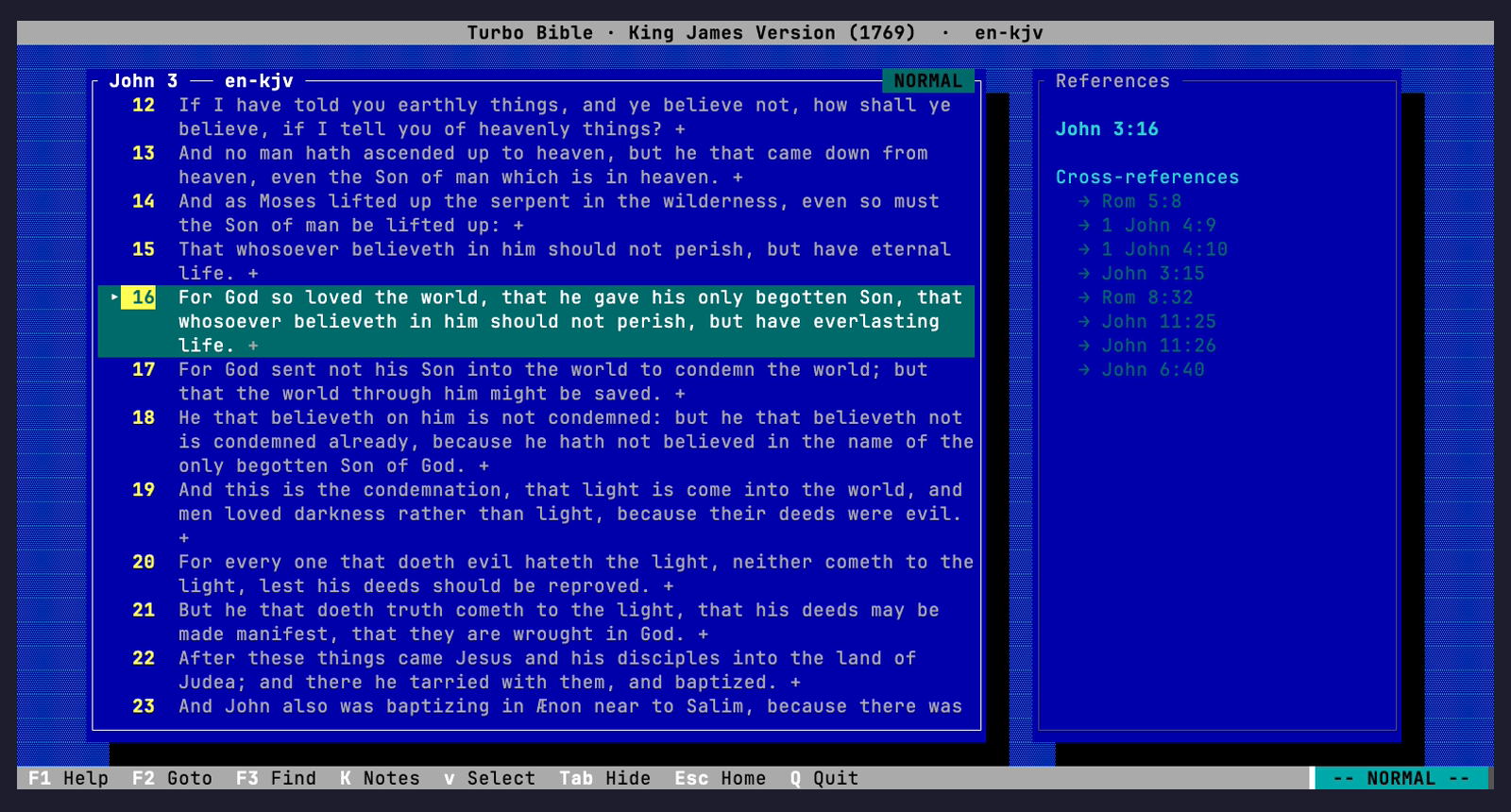
// real capture — verse cursor, cross-reference sidebar, John 3:16 in KJV.
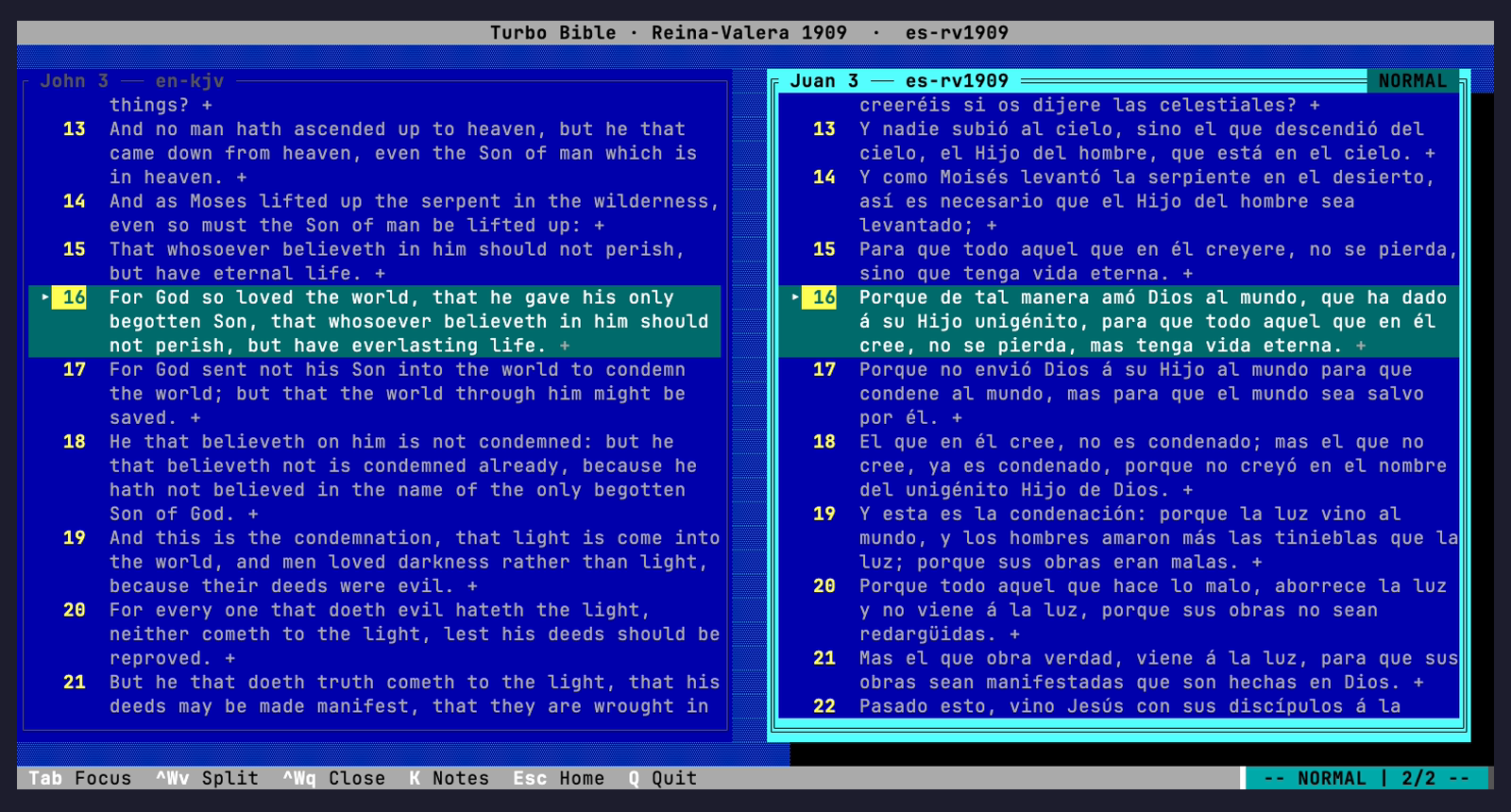
// John 3:16 in KJV and Reina-Valera 1909 — two independent panes, one keystroke apart.
What it does
eight features, all canonicalSmitingly fast.
Written in Rust. Type a phrase, get every match across every translation in under a heartbeat. No "Did you mean…" No "top results from the web." No tracking pixels. Just verses.
Vim keybindings, all the way down.
hjkl, /, gg, n, : — they all work. Your muscle memory transfers. Your wrists rejoice.
Eleven translations, seven languages.
English, Norwegian, Spanish, German, French, Portuguese, Latin. KJV through the Clementine Vulgate. Press t to switch; the cursor stays on the same verse.
Compare, side by side.
Ctrl-W v splits the screen into independent panes — KJV beside the Vulgate, or a cross-reference beside the verse that cites it. Each pane scrolls, searches, and selects on its own; vim window chords move between them. Same passage, same language? Diverging words light up — Ctrl-W d toggles the word-level diff.
Cross-references, built in.
Every verse links to the verses it quotes or echoes. Two keystrokes to follow Paul back to the prophets. Two more to come home.
Bookmarks, visual selection, clipboard.
Press b to bookmark a verse, v/V to select a range, y to copy verse + reference. Quotes show up in your notes already attributed. Mouse works too — click or drag to select, shift-click to extend.
Bring your own translation.
Got a public-domain version we don't ship — or your own study text? turbo-bible import turns a JSON file into a first-class translation: searchable, selectable, indistinguishable from the rest. No data pipeline, no recompile.
Offline. No telemetry. No accounts.
Your reading stays between you and the page. The app works on a plane, in a cave, in a fallout shelter, on a network with no internet. The only thing it ever checks is whether there's a newer version — see below.
Just scripture, in a window that looks the same in 2026 as it would have in 1992.
Web Bibles want your engagement metrics. Phone apps want your attention. Both want your data. A terminal app wants none of that — it just wants to show you the text. Turbo Bible is fast because nothing is in the way. It's distraction-free because the terminal is. And it's permanent: the text doesn't update, the layout doesn't shift, the company doesn't pivot. The Word was good enough for parchment; it's good enough for VT100.
Three commands. No prayer required.
Install
One line. No dependencies. No Node. No Python. No virtual environment called eden.
Have Rust? cargo install turbo-bible pulls the same binary from crates.io.
Run
Opens to the TURBO BIBLE splash with a filterable book picker. Enter opens a book; your last reading position is restored on next launch.
Read
Press / to search. Press gg to jump anywhere. Press F1 for the keymap. Press q to quit, like Lot leaving Sodom.
FAQ
frequently askedQ.Which translations are included?
Eleven, across seven languages. English: KJV, ASV, YLT, Douay-Rheims, Berean Standard. Norwegian: Bibelen 1930. Spanish: Reina-Valera 1909. German: Menge-Bibel. French: Crampon 1923. Portuguese: Bíblia Livre. Latin: Clementine Vulgate. All public domain or CC0/CC-BY. The King James Version ships inside the binary; the other ten download on first open (the curl installer pre-stages all eleven, so a curl-installed copy is fully offline). Modern in-copyright translations aren't, for the obvious commercial-law reason.
Q.Can I add a custom translation?
Yes. turbo-bible import yours.json --code xx-myver --name "My
Version" --language xx builds a SQLite database and installs it
alongside the bundled eleven — searchable and selectable like the
rest, no data pipeline or recompile. The input is a simple
books → chapters → verses JSON keyed by OSIS code; the docs cover the
full format and schema. If it's in a binder in your closet, scan it in
like a pilgrim.
Q.Does it phone home?
No telemetry, no analytics, no accounts — ever. The one network
call it makes is an optional, once-a-day glance at GitHub's releases
page to see whether a newer version exists. If one does, the splash
shows you the upgrade command for however you installed
(brew upgrade, cargo install --force, or the
curl one-liner) and nothing else — it never downloads or replaces
itself behind your back. Silence it with [updates] check =
false or TB_NO_UPDATE_CHECK=1.
Q.Why a TUI? Is this a joke?
No. The terminal is where developers already live, terminal apps are faster and more focused than web or mobile apps, and the Turbo Vision aesthetic is genuinely pleasant to look at. The Bible is text. Text is what terminals are for. If we wanted to put scripture in a JavaScript framework, the apostles would weep.
Q.Is this affiliated with any church or denomination?
No. Turbo Bible has no position on the Trinity, predestination, infant baptism, or whether the antichrist will be a programming language. It renders the text you ask for and gets out of the way.
Ready when you are._
// ~55 MB download, eleven translations, every cross-reference. tested on three monotheisms.
Free. MIT/Apache-2.0. Older than computers. Source on GitHub · Documentation
Every project has a genealogy. This one's reads git log --author=God — which returns nothing, humbling or heretical depending on your tradition. Turbo Bible is kept by one steward: not a theologian, no seminary, strong opinions about hjkl. The translations are public domain. The code is MIT. The text is older than computers, and needed no changelog.